


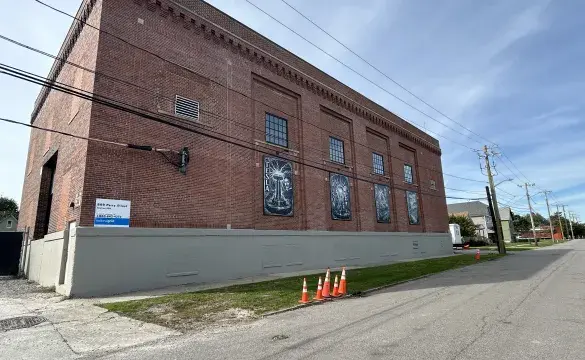
Modernized, Upgraded Buffalo Substation to Support Projected Electricity Load Growth, Economic Development
110-year-old site, bolstered by $32 million investment, is first milestone in multi-year reliability and resiliency plan
To meet anticipated load growth across Buffalo, National Grid has modernized and upgraded its Perry Street substation. The facility’s outgoing distribution delivery voltage has traditionally been 4,160 volts. But, as a result of a recently completed $32 million construction project, it now has the addition of 13,200-volt delivery to serve some large loads in the Larkinville and First Ward areas of the city. The Perry Street station represents the first of around a dozen substations that the company will either modernize or rebuild in the coming years to ensure that supply can meet projected demand increases. At the same time, it ensures that customers will continue to receive resilient, reliable electricity.
“Growth across the City of Buffalo is driving change in electricity delivery,” said National Grid Regional Director Ken Kujawa. “The renovations at our Perry Street station were both necessary and a direct response to load growth in Larkinville and the First Ward that include projects exceeding 1 megawatt. As we look ahead, this substation project and others like it are part of our current planning process to meet increased electricity demand and anticipate capacity needs across the city.”
Kujawa added that the original substation, built in 1916, has served the area well. But it was built at a time when large electricity loads weren’t as commonplace or anticipated as they are today. The new station cost $32 million to renovate and went online this past summer.
“Currently as many as two dozen mixed reuse, affordable housing, commercial, and retail projects are either in the planning or construction phases, and with this new station in place, we’ll be able to support additional load growth,” Kujawa said, adding that other factors including deployment of electric heat and expansion of electric transportation also will require more electricity.
National Grid installed murals on the brick wall facing Perry Street that include images of electricity pioneers who spent time in Western New York. Depicted, with their inventions, are:
Thomas Edison, Jacob Schoellkopff, Nikolai Tesla, and George Westinghouse. All spent time in the region and played significant roles in the eventual harnessing of hydroelectric power in Niagara Falls and transmitting high-voltage electricity to Buffalo in 1896.
As part of National Grid’s long-term infrastructure investment plan, additional portions of the City of Buffalo will also be converted to 13,200-volt delivery. Doing so will require modernizing and upgrading older substations, retiring others, and building some new ones.
“Modernized and upgraded facilities allow us to continue to prepare for electric load growth while at the same time, support economic development opportunities and continue to provide safe, reliable, resilient electricity upon which our customers in the City of Buffalo have come to rely,” added Kujawa.
About National Grid
National Grid (NYSE: NGG) delivers electricity and natural gas to more than 20 million people across New York and Massachusetts. We’re committed to meeting our customers’ energy needs and supporting economic growth across the regions we serve—providing safe, reliable energy today and building the resilient networks of the future. National Grid Ventures, our commercial business, develops and operates infrastructure that delivers affordable and reliable energy to consumers. National Grid Partners, our venture capital and corporate innovation arm, invests in and collaborates with technology companies that are accelerating the future of energy and helping new technologies reach critical scale faster.
For more information, please visit our website, follow us on X, watch us on YouTube, like us on Facebook and find us on Instagram.