



National Grid completes electricity tunnel breakthrough 49 days ahead of schedule
- Tunnel boring machine Caroline has completed her 2.2km drive beneath the River Thames, marking the end of tunnelling on National Grid’s Grain to Tilbury project
- Breakthrough was achieved 49 days ahead schedule, following exceptional tunnelling performance
- The milestone supports National Grid's work to strengthen the electricity network and connect cleaner, home-grown energy to homes and businesses
National Grid has reached a major milestone on its Grain to Tilbury project, part of The Great Grid Upgrade, after tunnel boring machine (TBM) Caroline successfully completed her breakthrough under the River Thames on Sunday 27 September after excavating a new 2.2km high-voltage electricity cable tunnel between Tilbury in Essex and Gravesend in Kent.
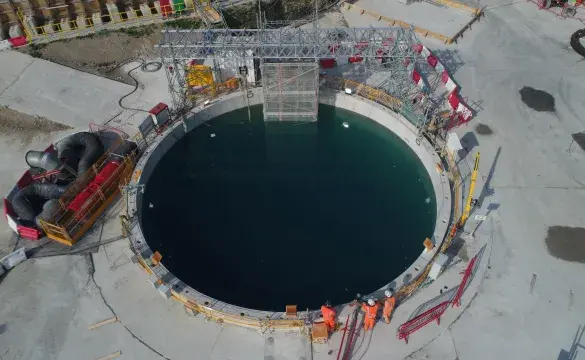
Caroline completed the final stage of her journey underwater, with the reception shaft intentionally flooded to balance pressure between the shaft and surrounding chalk ground and reduce the risk of groundwater entering the shaft during the final stage of tunnelling.
With more than 10,000 concrete tunnel segments installed to create the tunnel lining, and nearly 1,700 tunnel rings constructed, the breakthrough marks the completion of the project's tunnelling phase. The milestone was achieved 49 days ahead of the original programme following an exceptional tunnelling performance by teams working on the 2.2km drive beneath the River Thames.
The achievement was supported by close collaboration between National Grid, delivery partner Ferrovial BEMO JV, design partner Mott MacDonald and tunnelling specialist Herrenknecht. Careful planning, favourable ground conditions, and the proven performance of the tunnel boring machine all contributed to the early breakthrough, alongside well-coordinated logistics that kept tunnel segments continuously delivered to the TBM, while a dedicated separation plant reliably processed excavated material uninterrupted and efficiently.
Combined with the expertise of engineers, operators and construction teams, Caroline maintained strong progress throughout the tunnelling phase. In the most productive month, she advanced 926 metres and installed 712 tunnel lining rings. At peak performance, the machine advanced 229 metres in a single week, while its best daily output saw 41 metres excavated and 31 tunnel rings installed in just 24 hours.
Digital design tools and connected TBM data also supported delivery by improving visibility, quality assurance and decision-making. An integrated underwater telescopic camera allowed inspections to be carried out remotely, reducing the need for personnel intervention and supporting safe working practices.
Mark Farmer, Project Director, National Grid, said:
"The breakthrough of TBM Caroline is a fantastic achievement and a major milestone for the Grain to Tilbury project."
"Completing this tunnel drive ahead of schedule is a testament to the expertise, dedication and collaboration of our teams and supply chain partners. Everyone involved has worked together to deliver an exceptional performance safely and efficiently, helping us reach this important milestone sooner than anticipated."
"This project will play a critical role in strengthening the electricity network and supporting Britain's future energy needs as demand for cleaner electricity continues to grow."
Borja Trashorras, Project Director, Ferrovial BEMO JV, said:
“Reaching breakthrough ahead of schedule is the result of excellent planning, strong engineering expertise and outstanding collaboration across the project team.”
“The combination of diligent planning, efficient logistics, innovative tunnelling technology and a highly skilled workforce enabled us to achieve consistently strong performance throughout the drive. We are extremely proud of this achievement and of everyone who contributed to making it possible.”
Ulrich Schaffhauser, Member of the Board, Herrenknecht AG, said:
“The fast completion of the cable tunnel beneath the River Thames shows the value of effectively coordinating all project components, technologies, and services. With our product and service portfolio, we were able to deliver not only the TBM tailored to the operating conditions, but also the corresponding separation equipment and tunnel logistics for continuous tunnelling performance.”
"This breakthrough demonstrates what can be achieved when advanced tunnelling technology, efficient project execution and strong teamwork come together. We congratulate the entire project team on reaching the breakthrough safely and successfully."
The shaft at Gravesend was intentionally flooded before breakthrough. Due to the local chalk ground conditions, the shaft had to be flooded, creating a balanced hydrostatic pressure between the shaft and the surrounding ground. This significantly reduced the risk of groundwater flowing into the shaft as the machine broke through.
Following the breakthrough, activities will continue to allow TBM Caroline to advance beyond the shaft wall and reach its final position, enabling the remaining ring-segment construction works to be completed.
Dewatering of the shaft started in September and will continue through October. Once complete, the TBM will be lifted, before being disassembled as the project progresses into its next phase of construction.