



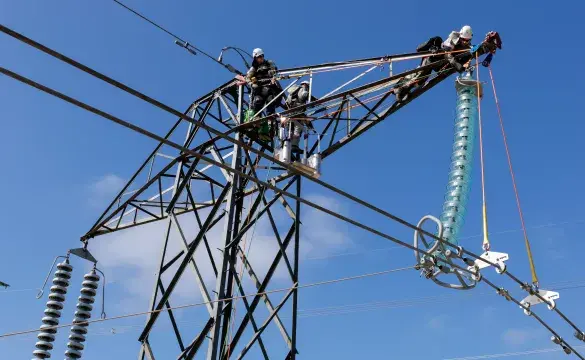
Live working moves a step closer after National Grid secures innovation funding
Four National Grid projects have secured more than £5 million through the next stage of Ofgem's Strategic Innovation Fund (SIF) programme, including a project that could reintroduce live working on the UK transmission network for the first time in a generation – supporting faster delivery and reducing system costs.
The projects span both the Discovery and Beta phases of the SIF programme, which supports the development and testing of new technologies and approaches to help transform Great Britain’s energy networks.
National Grid Electricity Transmission (NGET) has been awarded £4,947,031 for the DEsign for Live Line Technology Acceleration (DELLTA) three-year Beta phase project.
Maintenance on transmission assets is typically carried out during planned outages, when circuits are taken out of service, which can be costly and difficult to schedule. By enabling maintenance on live assets, DELLTA could reduce outages, maintain network capacity and help accelerate vital grid reinforcement.
It follows a successful Alpha phase and will see the project continue to develop techniques that could enable maintenance to be safely carried out on high-voltage transmission networks while they remain energised.
DELLTA is being led by National Grid Electricity Transmission in partnership with Frazer-Nash Consultancy, The University of Manchester, Allied Insulators, The University of Liverpool and SSEN Transmission as well as the Budapest University of Technology and Economics to learn global best practice.
During its Alpha phase, the project successfully demonstrated a proposed live insulator replacement method on a de-energised network. The new funding will support a three-year Beta phase which will further develop the advanced equipment, procedures and training required for live working.
The project's main focus will be the live replacement of overhead line insulators, but will also explore other potential live working uses. It will see a team being trained in carrying out live working, with the project culminating in a demonstration of techniques and technologies on NGET’s network.
The overall ambition of the DELLTA project is for live working to be a business-as-usual tool for the transmission network.
NGET is also a partner on the Quantum optimisation for future gas network design project, which is being led by National Gas and has been awarded £616,558 of SIF Alpha phase funding.
The project will look to develop a quantum computing inspired optimisation approach to improve outage planning in gas transmission, but also has the potential to be applied across electricity networks, supporting whole-system planning and improving efficiency.
Neil McClymont, Head of Innovation at National Grid Electricity Transmission, said:
“As demand for electricity grows, innovation is essential in helping us futureproof the network. These projects will help us explore new technologies, techniques and approaches that can support a more flexible and resilient network.
“The DELLTA project is particularly exciting as it has the potential to transform how we work by developing the equipment and techniques needed to safely carry out maintenance on the transmission network while assets remain in service, reducing the need for planned outages and minimising associated costs.”
The projects are funded through the Strategic Innovation Fund, an Ofgem programme managed in partnership with Innovate UK.
National Grid Electricity Distribution (NGED) has been awarded almost £550,000 for three projects.
DISPATCH, which stands for Data-Integrated Systems for Power Transmission and Community Heat, will investigate how the siting of data centres could have spin-off benefits. It will examine if medium-size centres can provide low-temperature waste heat to benefit households with extra needs, and look at the potential of sharing flexibility service income with heat networks.
SOS Racer (Security of Supply - Revised Approach to Consider Embedded Resources) will assess how battery storage, solar and wind farms could provide additional assurance that the electricity system can be secure at times of peak demand. It will examine how distributed demand-side flexibility can also inform future resilience, planning and market frameworks.
The third NGED funding award is for the Innovation Delivery Group (IDG) charter discovery project looking at decentralised system balancing.
The IDG, which is chaired by National Grid Electricity Distribution’s DSO managing director Cathy McClay, with Rebecca Beresford of the National Energy System Operator (NESO) as vice chair, will set out clear delivery pathways and identify gaps in the products, services and capabilities needed for decentralised system balancing. These findings will help inform decisions on which future innovation projects could best address those gaps.
Emily Spearman, Director of Innovation at National Grid Electricity Distribution, said:
“These projects highlight how innovation can help tackle some of the biggest challenges facing the future energy system, from strengthening security of supply and enabling decentralised system balancing to creating wider benefits for customers and communities.
“By working with partners across the sector, we can turn new ideas into practical solutions that support a more resilient, flexible and affordable electricity network.”