




Our proposals
We are proposing to upgrade the electricity transmission network by building a new high-voltage electricity transmission line and associated works in Derbyshire. The overhead line will connect a new substation at Chesterfield to the existing Willington Substation.
How have our proposals changed since Stage 1?
Key changes since Stage 1 include:
- identifying a more detailed route for the overhead line (known as the Proposed Route Alignment);
- presenting an alternative route between Astwith and Alfreton to the east of the Stage 1 corridor (the area of land where the overhead line route could be developed), avoiding sensitive areas such as the River Amber valley, Ogston Reservoir, and listed buildings such as Ogston Hall; and
- proposals for a new substation at Chesterfield.
Our updated proposals for Chesterfield to Willington include:
- a new 400 kV overhead line, approximately 60 kilometres (km) in length between a new substation in the Chesterfield area and the existing Willington Substation;
- a new 400 kV substation at Chesterfield, to be built next to the existing 275 kV Chesterfield Substation and the existing 132 kV National Grid Electricity Distribution (NGED) substation to the south east of Chesterfield (referred to as the ‘new Chesterfield Substation’);*
- replacement of short sections of existing overhead line and local changes to the lower voltage distribution network to facilitate the construction of the Project; and
- other works needed for construction, such as temporary access roads, highway improvements, construction work compounds, ancillary works, utility diversions, and drainage. Land would also be required for environmental mitigation and enhancement, which would deliver an overall Biodiversity Net Gain (BNG), an approach to development that leaves habitats in a better state than before.
*The new Chesterfield Substation is expected to be delivered by NGET’s Brinsworth to High Marnham project. However, it is possible that it could be included in this Project's Development Consent Order (DCO) application using land we already own and minimising visual impacts. This approach allows National Grid to demonstrate that the Project can be delivered and that it can connect to the national electricity transmission network.
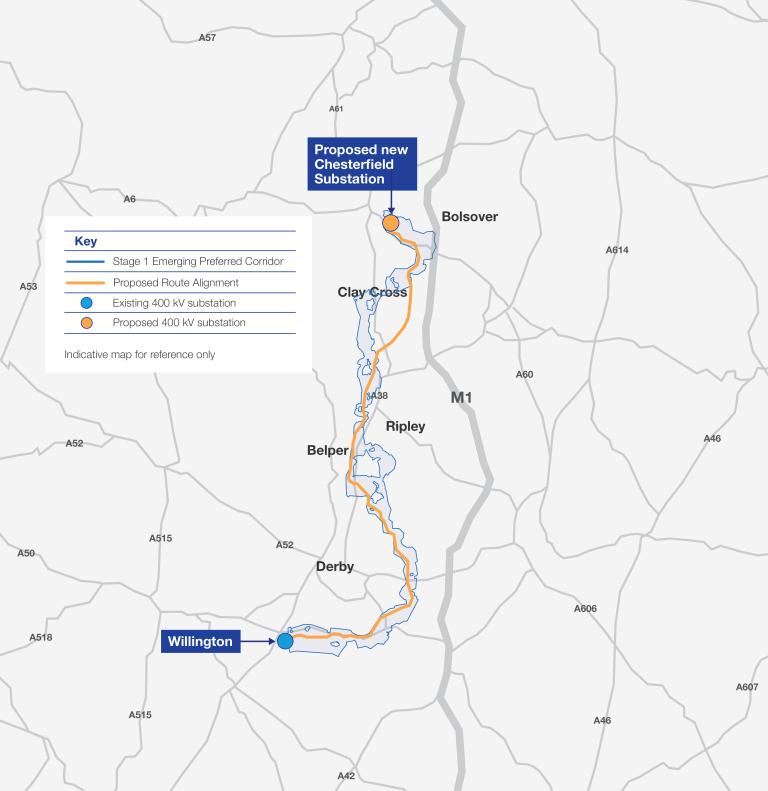
Proposals by location
Similar to Stage 1 consultation, the proposed route for Stage 2 consultation was split into six Route Sections to make it easier to view and provide feedback about areas of particular interest. More detailed information can be found in our Stage 2 Consultation Document.
Each section below explained how the Proposed Route Alignment and draft Order limits (the working area we are looking to obtain consent for) had been refined or changed against Stage 1 proposals.
We are now including proposals for a new Chesterfield Substation located adjacent to the existing National Grid Electricity Transmission substation at Calow. Please provide any feedback that you may wish to make directly to National Grid about the proposed new Chesterfield Substation through this consultation.
The substation is proposed to be Gas Insulated Switchgear (GIS) as it is more compact than Air Insulated Switchgear (AIS) and there’s limited space available at the site. This means that most of the equipment would be housed within a single building. There would also be connections and modifications to the existing 275 kV overhead line and 132 kV underground cables to accommodate the new substation.
Click here to look at the detailed Chesterfield substation plan within Route Section 1.
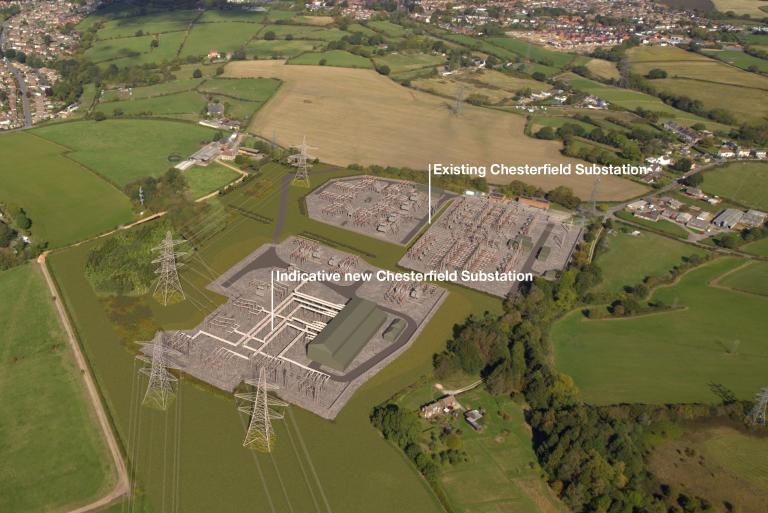
Indicative CGI of the new 400 kV Gas Insulated Switchgear (GIS) substation design
This section starts to the south east of Chesterfield, where the new Chesterfield Substation would be located. From here, the Proposed Route Alignment heads south east, travelling from the west of Hassocky Lane towards Heath, before turning south. It then continues through Stainsby, Astwith and Hardstoft, before ending near Tibshelf.
This section would require the undergrounding and re-routeing of various existing 132 kV overhead lines where they intersect the proposed route, and adjustments to other lower voltage wood pole overhead lines.
Changes outside the Stage 1 corridor
We are now presenting an alternative route outside the corridor presented at Stage 1. This would run between Astwith and Tibshelf and beyond to Oakerthorpe. This is in response to further technical studies and Stage 1 feedback which expressed local concerns about the landscape and access, particularly around the River Amber valley, and to reduce impacts on the natural environment, views and the wider landscape.
Click here to look at the detailed Route Section plan, or watch the fly-through video of this section below.
This section begins at Doe Hill Lane (B6014), to the west of Tibshelf, and heads south west towards Alfreton. From there, it continues south, broadly following the direction of the A38 past Pentrich, before ending at Lower Hartshay, just south of the A610.
This section would require the undergrounding and re-routeing of part of an existing 132 kV overhead line (from Chesterfield to Alfreton), where it would cross the new line near the Alfreton Substation, and adjustments to other lower voltage wood pole overhead lines.
Changes outside the Stage 1 corridor
We are now presenting an alternative route outside the corridor presented at Stage 1 that avoids most of the River Amber valley. In Route Section 2 this is between Tibshelf and Oakerthorpe. This is in response to further technical studies and Stage 1 feedback which expressed local concerns about the landscape and access, particularly around the River Amber valley, and to reduce impacts on the natural environment, views and the wider landscape.
Click here to look at the detailed Route Section plan, or watch the fly-through video of this section below.
This section runs from the west of Ripley south to Morley. From near the A610 at Lower Hartshay, the Proposed Route Alignment heads south, following the western side of the A38 corridor. It passes the communities of Cinderhill, Holbrook and Kilburn, before crossing the A38 between Horsley and Coxbench and continuing to Morley.
This section would require the undergrounding and re-routeing of a section of an existing 33 kV overhead line and adjustments to other lower voltage wood pole overhead lines.
Click here to look at the detailed Route Section plan, or watch the fly-through video of this section below.
This section begins to the north east of Morley Smithy, where the route crosses the A608, before continuing south east. The route then passes to the south west of Stanley and curves around Locko Park. From there, it continues south to the A6096 (Dale Road), before turning south west and passing around the north east side of Ockbrook.
This section would require the undergrounding and re-routeing of an existing 132 kV overhead line where it intersects the proposed route, and adjustments to other lower voltage wood pole overhead lines.
Click here to look at the detailed Route Section plan, or watch the fly-through video of this section below.
This section continues from the south east of Ockbrook and travels generally south. After crossing the A52 (Brian Clough Way), the Proposed Route Alignment continues south across the A6005 and the Derby to Nottingham railway line between Borrowash and Draycott.
It then crosses the River Derwent and curves around Ambaston and Elvaston, before turning south west to avoid passing directly through these settlements. The route then continues south west between Thulston and the Trent Valley Crematorium, before crossing the A6 Derby Spur near Junction 2 of the A50 and following the A50 towards Chellaston.
This section would require adjustments to other lower voltage wood pole overhead lines where they intersect the proposed route.
Click here to look at the detailed Route Section plan, or watch the fly-through video of this section below.
This is the final part of the route which runs from Aston-on-Trent to Willington Substation. The Proposed Route Alignment begins to the north west of Aston-on-Trent and heads south west. After crossing the A50, it runs parallel to the Castle Donington railway line, remaining to the south of the A50, before crossing the Trent and Mersey Canal and the railway line just north of Barrow upon Trent. From here, the route continues broadly alongside the A5132 (Twyford Road) before entering Willington Substation from the north east.
This section would require the undergrounding and re-routeing of various existing 132 kV overhead lines where they intersect the proposed route, and adjustments to other lower voltage wood pole overhead lines.
National Grid is developing separate plans for an extension to the existing Willington Substation to facilitate new customer connections. It is anticipated that these extension works would be delivered via permitted development rights and are expected to be completed by 2029. If confirmed, this potential development will be considered as part of the Project's cumulative assessment within the Environmental Statement, submitted as part of our application for development consent.
Click here to look at the detailed Route Section plan, or watch the fly-through video of this section below.
What happens next?
The feedback we received at Stage 2 consultation will help us to further refine our proposals for Chesterfield to Willington before we submit an application for a DCO to the Planning Inspectorate.
All feedback received as part of the consultation will now be carefully considered, alongside ongoing technical and environmental assessments.
The steps after Stage 2 consultation are:
- Engagement: We will continue discussions with landowners, local elected representatives, local authorities, and other stakeholders.
- Technical work: Further technical studies and surveys will be carried out in the Project area.
- Updates: Regular updates will be provided on the Project website, and by email to those who have registered to be kept informed.
- Refining our plans: We will further refine our proposals based on feedback and findings from technical studies.
- DCO application: We will prepare our application for a DCO, which will include a Consultation Report detailing how we have taken account of feedback.
The Planning Inspectorate will examine our proposals and make a recommendation on the application to the Secretary of State, who will make the final decision on whether to grant consent. If approved, we expect to start construction in 2029, with Chesterfield to Willington becoming operational by 2031.
What's energy resilience got to do with movie marathons?
Find out how – and why – we’re connecting more cleaner energy to power the things you love.