



Help shape your Community Fund
National Grid has a long-standing commitment to the communities we work alongside, and we want to ensure lasting benefits for the people and places that host our energy infrastructure.
Our work on the Didcot substation means we will deliver a Community Fund of £530,000 to support community priorities in Didcot and surrounding areas.
Shaped by the community, for the community, this fund will be designed to reflect local needs and aspirations.
Your response to this survey will help us understand what’s most important to you and how the funding can make a positive, lasting impact.
Please complete our two-minute survey by Tuesday 27 October 2026.
Please refer to our FAQs below for more information.
There are plenty of opportunities to get involved and speak to the National Grid team – catch them in and around Didcot in September and October or join the online session:
Didcot Garden Town Community Update Meeting
30 September 2026, 5pm to 7:30pm
Harwell Village Hall, OX11 0EX
Pop-up event at The Orchard Centre, near Sainsburys
6 October 2026, 1pm to 5pm (Central Drive, Didcot, OX11 7ND)
Online webinar – 13 October 2026, 6pm to 7pm. If you’d like to attend this event, please sign up via the link: https://forms.cloud.microsoft/r/7KfinZFSVJ
We’re extending our existing Didcot substation to improve the grid resilience and facilitate new connection requests to our network.
Project Overview
We are carrying out works to extend the existing 400kV Didcot substation which will include the installation of three new transformers and a new 132kV GIS substation on the site. These additions will help meet growing demand for flexible, zero carbon power in the region and help to power Oxfordshire’s digital future.
We are supporting the energy transition to clean power and enabling the grid to meet the region’s energy needs for years to come.
The 400kV substation supports the transmission of high voltage electricity to where it’s needed in the UK
The 132kV gas-insulated switchgear (GIS) facility is being built to connect data centres and battery storage systems to the grid
The network has seen an increase in demand for energy from data centres and battery energy storage systems (BESS). Providing battery connections helps to boost grid flexibility and data centres help to support the regional and national economy, powering the UK’s digital ambitions.
There will be no disruption to the supply of electricity in Didcot during these works.
The working area is highlighted on the map below and will form the location of the new extended substation.
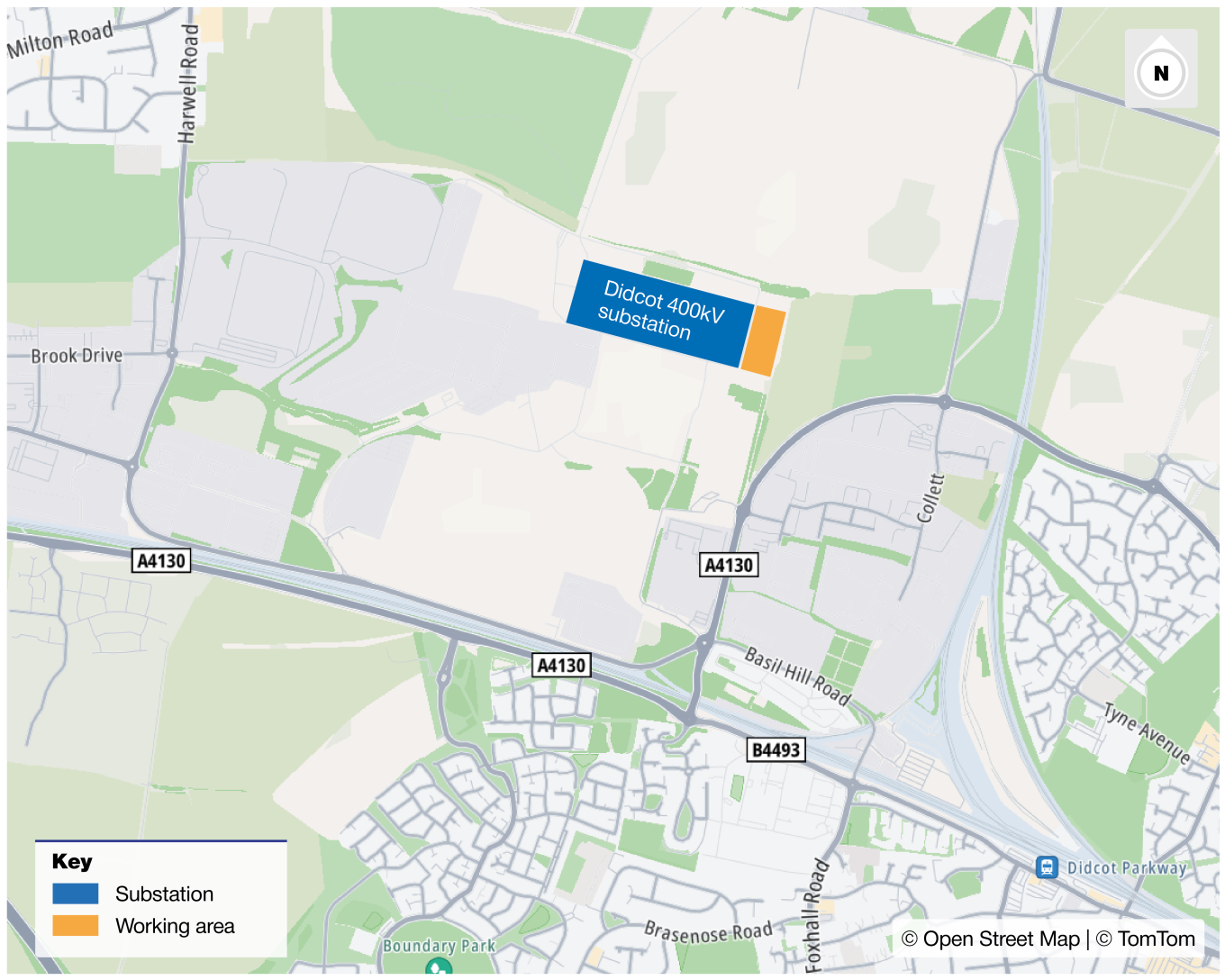
What you can expect to see
Works begun in 2025, and the team are expected to be on site until early 2029.
Our working hours will be:
- 8am to 6pm Monday to Friday
The work will be carried out by our Principal contractor, Linxon, on behalf of National Grid.
We don’t anticipate our work causing any major disruption, but you may hear some noise while we are working or notice some construction vehicles in your local area. We are carrying out this work under National Grid's permitted development rights and will ensure our works comply with environmental licensing requirements.
Project and Community Fund Frequently Asked Questions
Here you’ll find answers to some of the most frequently asked questions about the Didcot substation project.
Substations are integral features of the transmission and distribution networks enabling electricity to be transmitted at different voltages, securely and reliably. One of the main roles of substations is to convert electricity into different voltages. This is needed so electricity can be transmitted throughout the country and then distributed into our homes, businesses, and buildings.
The additional connections are needed to connect new customers to our transmission network to meet an increase in electricity demand to the west of London. As a regulated business, we have a legal obligation to connect customers to our network when a connection is requested.
The substation extension will facilitate a range of technologies including data centres and battery energy storage systems (BESS). The data centres are buildings dedicated to housing computers and digital storage.
Construction vehicles, including HGVs will bring people and materials to and from site. Although you may notice these construction vehicles in your local area, we are not planning to work on any other roads in the area. Heavy good vehicle (HGV) transport routes are agreed in advance and are carefully monitored to ensure contractors are correctly following them. They are focused on the strategic road network, not smaller local roads.
There will be no disruption to the supply of electricity during these works.
As well as meeting the needs of our local customers, the extended substation is a key part of National Grid’s nation-wide expansion of the grid network to meet the power demands of the future.
Under National Grid’s community benefit programme, communities hosting new electricity transmission infrastructure are entitled to apply for funding from National Grid. To ensure that our community benefit programme effectively serves your area, we are eager to hear local views and will soon be undertaking an engagement exercise to understand what matters most to the community and identify where community benefit funds can provide lasting advantages, including through community grant schemes, investments in community groups, or regional partnerships.
We want to understand what’s matters most to local people and how the funding can make a positive, lasting impact in your community
Understanding community needs is central to how the Community Fund is designed and delivered.
We started by reviewing data and local strategies to build an initial picture of the area, and have engaged with the local authority, and several local organisations and charities to better understand local needs and priorities. We are now holding a consultation to understand the key priorities of the local community.
Community feedback will help inform funding priorities, delivery approaches and investment decisions.
Following this consultation, we will clearly explain how community feedback has influenced our decisions and shaped our approach to delivering Community Funds. This may include updating proposals, refining funding priorities, or adjusting how benefits are delivered in response to what we hear.
We will share feedback summaries, explain the reasons for decisions, and keep communities informed as our plans develop.
Registered charities, not-for-profit organisations like sports clubs and Parent Teacher Associations, and local Parish Councils serving the eligible area can apply.
Eligibility is based on communities closest to the infrastructure linked to the Fund, in line with Government guidance. Government guidance is not prescriptive about boundaries, so the eligible area will look different for each project. We work with communities and stakeholders to identify an approach that reflects local circumstances.
When defining eligible areas, we may consider factors such as population density, administrative boundaries, natural boundaries, and service hubs and stakeholder feedback, taking a pragmatic, common-sense approach. For every project, we will clearly explain which areas are eligible and why.
We are proposing an eligible area for the Community Fund that algins with the Didcot Garden Town Area of Influence. Areas that sit in this boundary include: Didcot, Steventon, Milton Hill, Milton, Milton Park, Harwell, Harwell Campus, Chilton, Clifton Hampden, Little Wittenham, Sutton Courtenay, Culham, West Hagbourne, Upton, East Hagbourne, Blewbury, Appleford, River Thames, Culham Science Centre, Long Wittenham, East Hagbourne, Fulscot, South Moreton and North Moreton.
A map of the area can be found below, within the green and blue boundaries.
Organisations applying to the Community Fund do not need to be based in the eligible area, but they do need to demonstrate that they serve communities within it.
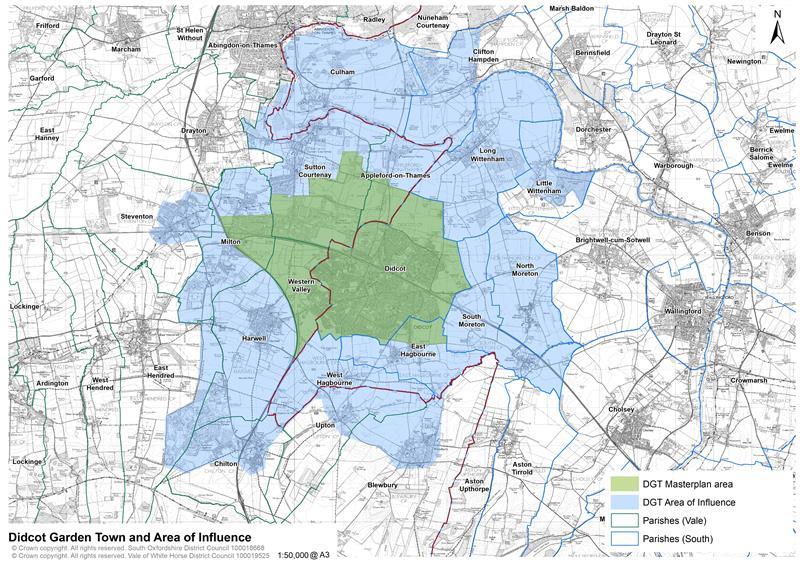
Please use this link to view a larger version of this map
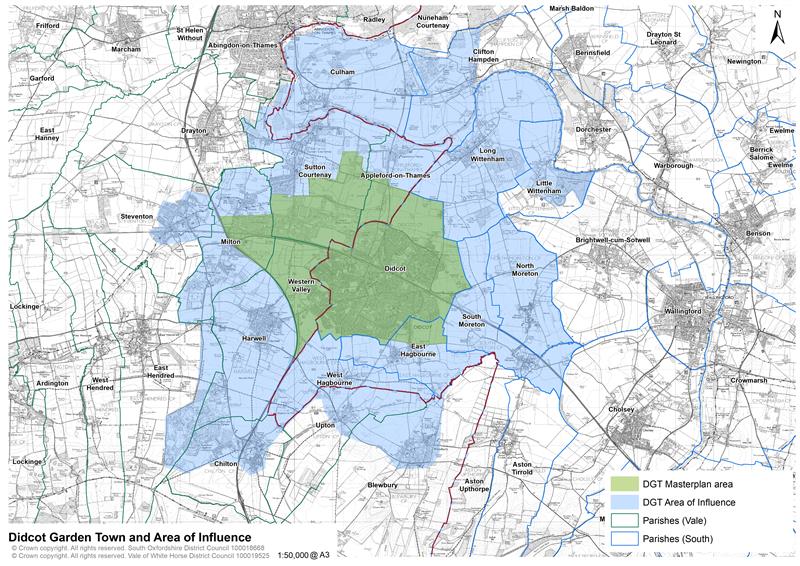
Map credit: South Oxfordshire and Vale of White Horse District Councils
Government guidance sets out principles for delivering community funds, providing flexibility over the types of investment that can be supported. Community funds can support a wide range of activities depending on local priorities. This may include funding for community projects, investment in local facilities, or initiatives that support skills, education or wellbeing.
This Local Fund guidance gives more detail.
Applications for the fund will open in early 2027. This public consultation is to determine priorities in the local area and help shape the fund design.
Get in touch
If you have any questions about the project, please get in touch with our Community Relations team:
Email: [email protected]
Phone: 0800 593 0530