



Frequently asked questions
National Grid sits at the heart of Britain’s energy system, connecting millions of people and businesses to the energy they use every day. We bring energy to life – in the heat, light and power we bring to our customer’s homes and businesses; in the way that we support our communities and help them to grow; and in the way we show up in the world. It’s our vision to be at the heart of a clean, fair and affordable energy future.
National Grid is a group of companies, and one of those companies, National Grid Electricity Transmission (NGET), owns, builds and maintains the high voltage network in England and Wales. It is NGET who is developing plans for the Middleton Substation project.
Within the National Grid Group there are other distinctly separate legal entities, each with their individual responsibilities and roles. More information about National Grid can be found on the ‘about us’ section of National Grid’s website.
NGET owns, builds and maintains the high-voltage electricity transmission network in England and Wales. This network operates primarily at 400,000 volts (400 kV) and 275,000 volts (275 kV).
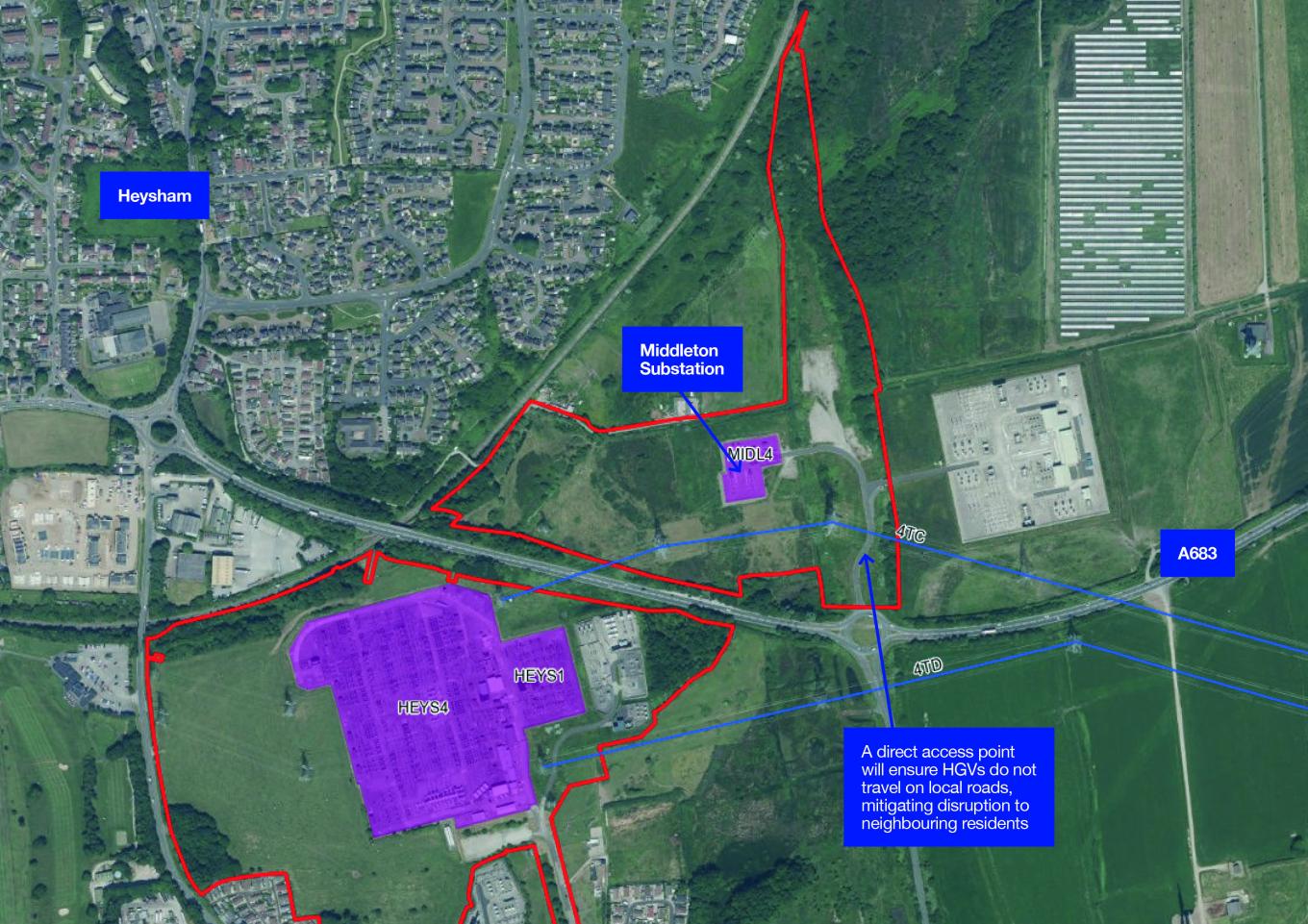
The highly strategic location of the site, close to the A683, allows vehicles to access the site directly without travelling through residential areas and on local roads, which will significantly mitigate disruption.
Vehicle movements will be largest during the construction period. During operation, vehicle movements to and from the site will be limited to only maintenance at the substation, typically significantly fewer than movements during construction.
Environmental assessments were undertaken, including habitat and protected species surveys as part of the planning application.
As the existing substation is located close to the Heysham Moss Site of Special Scientific Interest (SSSI), we will continue to work closely with Natural England to mitigate any potential impacts identified during construction and operation of the extension.
NGET proposes to deliver the required 10% Biodiversity Net Gain (BNG) through partnerships. NGET’s Nature and Carbon Framework enables the procurement of biodiversity units, with the 10% BNG to be achieved via offsite units. This approach has been agreed with the Biodiversity Officer at Lancaster City Council.
As part of our planning application, we carried out a noise assessment. The most likely potential for noise impacts will be from the piling activities on site. This will be for a limited period of time and will only take place during the specified working hours.
Various mitigation options will be considered, including seeking to alleviate noise and vibration through appropriate consultation and undertaking works in accordance with best practice standards.
Years of study and research have indicated that, as long as exposure to EMFs is kept under conservative guideline limits, there is no evidence of any risk to health for those living nearby. All National Grid equipment and operations comply fully with local exposure limits, and typical exposure to magnetic fields is a fraction below guideline limits.
As part of our planning application, we carried out a noise assessment to identify any areas where local residents might experience significant noise.
The most likely potential for noise impacts will be from the piling activities on site. This will be for a limited period of time and will only take place during the specified working hours.
At this stage, we are unsure what method of piling will be undertaken. During the detailed design phase of the project, the main works contractor will work with a specialist piling design contractor to develop a robust, site-specific strategy for piling design and construction methods. This collaboration will ensure that potential environmental impacts, particularly noise and vibration, are proactively identified and addressed.
Various mitigation options will be considered, including seeking to alleviate noise and vibration through appropriate consultation and undertaking works in accordance with best practice standards.
The final piling methodology will be selected and refined in consultation with specialist designers, balancing technical requirements and site constraints to ensure that the piling works are delivered in accordance with best practice and regulatory guidance.
The construction working hours will be:
Monday to Friday between 08:00 and 18:00.
Saturday between 08:00 and 13:00.
Sunday and public holidays - no working that is audible at the site boundary.
Any work outside these standard hours will need to be agreed on with Lancaster City Council’s Environmental Health Officer prior to commencing.
Our planning application was unanimously approved by Lancaster City Council’s Planning Regulatory Committee on 11 May 2026. The application can be found on the Lancaster City Council’s planning portal here or by searching this reference number: 25/01055/FUL.
Our next steps are to satisfy and discharge the various conditions attached to the consent and we will continue to work closely with officers at the council. Our aim is to start on site during summer 2026.
Contact us
If you have any questions, get in touch with our team by:
- Emailing: [email protected]
- Calling: 0808 303 4641